2 · One booking per room
The hotel’s system wants one booking per room. The booking has a list of rooms, so the process has to fan out: one branch per room, each one a small flow of its own, and then carry on when they are all done.
The definition
Section titled “The definition”02-rooms-booking.ec.yaml:
id: rooms-bookingname: Book every roomsteps:  - id: start    type: START    name: Booking received
  - id: register-booking    type: ACTION    name: Register the booking    preconditionStepId: start
  - id: rooms    type: PROCESS    name: Book every room    preconditionStepId: register-booking    outputVariables: [roomBookingId]       # what each room hands back    forEach:      items: rooms                         # a JSON array variable      as: room                             # each branch sees its room as `room`      label: "'Room ' + room.number"       # how each branch is named in the console      output: roomBookings                 # collected, in room order      outputElement: roomBookingId    steps:                                 # the branch, written in line      - id: start        type: START        name: Start      - id: create-room-booking        type: ACTION        name: Book the room        preconditionStepId: start      - id: end        type: END        name: End        preconditionStepId: create-room-booking
  - id: notify-guest    type: ACTION    name: Tell the guest    preconditionStepId: rooms
  - id: done    type: END    name: Done    preconditionStepId: notify-guest
Three ideas in one step:
forEachruns the step once per element ofrooms— in parallel by default (mode: sequentialfor one at a time).outputcollects what each branch produced, in the order of the rooms.type: PROCESSwithsteps:— the branch is a whole flow, written in line. Here it has a single action, but it can be as long as you need: book, confirm, notify. Each branch runs as a child process of its own, with its own variables, so branches never step on each other.labelnames each branch for people:Room 101rather thaniteration 0.
notify-guest waits for rooms, so it runs once, after every room is booked — the forEach is a fork and a join in one step.
The worker for one room:
public record CreateRoomBookingInput(Room room) {}public record CreateRoomBookingOutput(String roomBookingId) {}
@BeanTaskRegistration<CreateRoomBookingInput, CreateRoomBookingOutput> createRoomBooking() {    return new TaskRegistration<>("create-room-booking", 1, "hotel",            CreateRoomBookingInput.class, CreateRoomBookingOutput.class,            (input, context) -> new CreateRoomBookingOutput("RB-" + input.room().number()));}
Run it
Section titled “Run it”scripts/start.sh rooms-booking BOOKING-2 '{"guest": "Alice", "rooms": [ {"number": "101", "type": "double"}, {"number": "102", "type": "double"}, {"number": "103", "type": "double"}]}'In the Diagram, the rooms step shows 3/3: three branches, three completed. Double-click it to open it into its lanes — one per room, with the steps of its flow and their state:
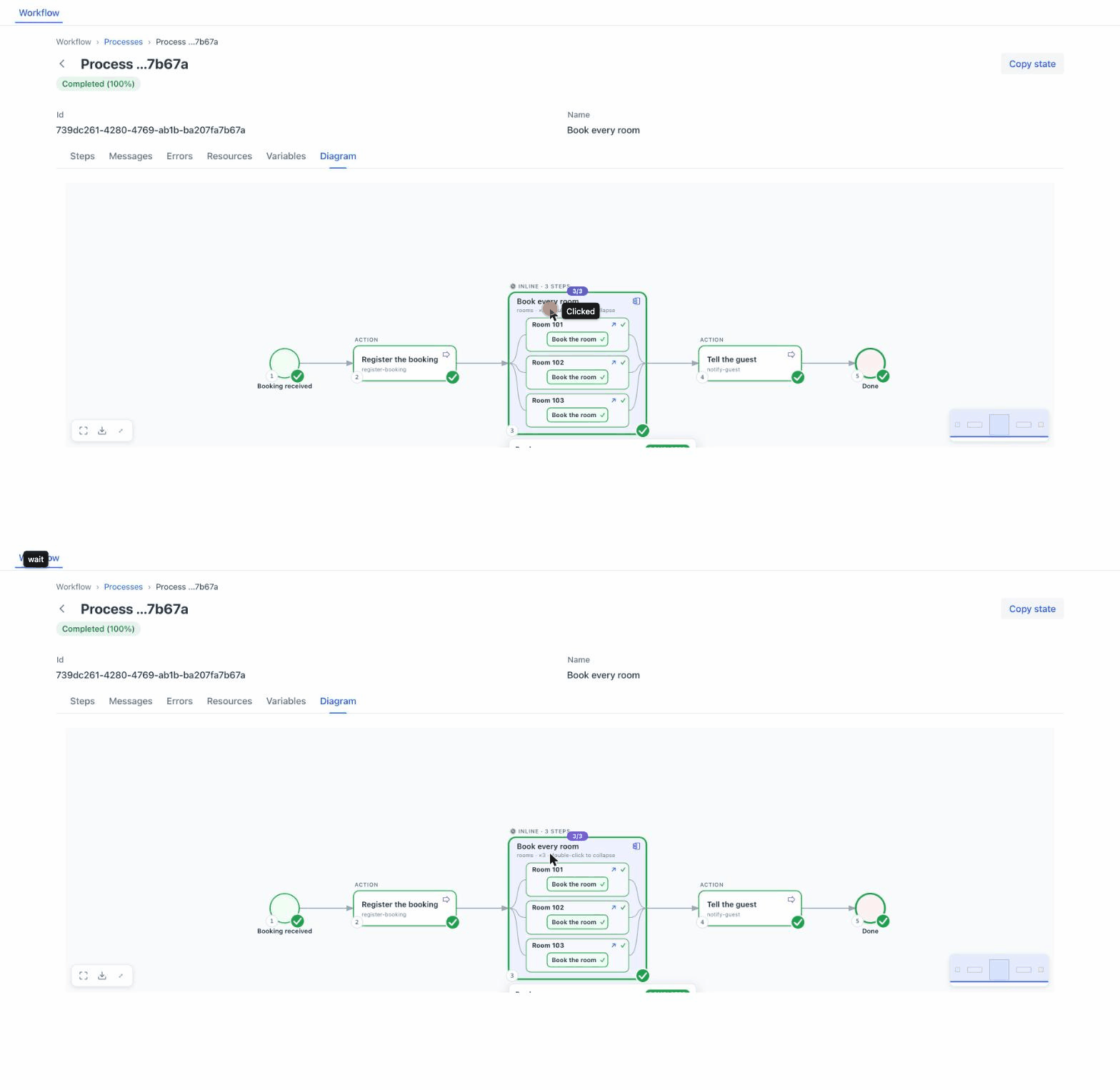
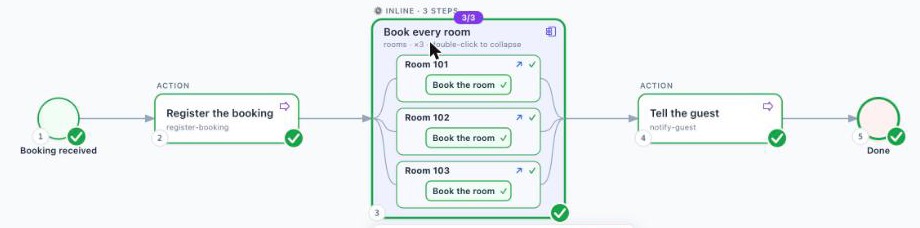
Double-click a lane’s header to open that room’s own run; double-click the node again to fold it.
-
roomsshows 3/3 and opens into three lanes named Room 101, Room 102, Room 103. - The Variables tab has
roomBookings, one id per room, in room order. -
notify-guestran once, after the three rooms.