10 · Changing without redeploying
The workshop app loads its definitions from its own classpath, so changing one means rebuilding and restarting the app. In production you rarely want that: the business process changes more often than the code around it. The engine can import definitions from a Git repository instead, and re-import it on a webhook — so a change ships by merging a pull request, not by redeploying a service.
A repository of definitions
Section titled “A repository of definitions”For the workshop, a local repository will do:
mkdir ~/hotel-definitions && cd ~/hotel-definitions && git init -b maincp …/examples/workshop-hotel-booking/src/main/resources/workflows/06-hotel-booking.ec.yaml hotel-booking.ec.yamlgit add . && git commit -m "hotel-booking v1"Start the app pointing at it:
mvn spring-boot:run -Dspring-boot.run.arguments="\ --workflow.git-import.repositories[0].url=file://$HOME/hotel-definitions \ --workflow.git-import.repositories[0].branch=main"WorkflowDefinitionGitImportRunner : Starting workflow definition import from 1 Git repository/ies…WorkflowDefinitionGitImportRunner : Imported 1 workflow definition(s): [Hotel booking [hotel-booking]]In production the URL is your definitions repository (HTTPS with a token, configured as a secret), and the configuration is workflow.git-import.* — see Importing from Git.
A booking on the current version
Section titled “A booking on the current version”scripts/start.sh hotel-booking BOOKING-8 '{"guest": "Gus", "rooms": [ {"number": "201", "type": "double"}, {"number": "202", "type": "double"}]}'It waits for the manager’s approval — a booking that will still be running when the definition changes.
Change the process
Section titled “Change the process”The hotel wants the assistant to draft the confirmation email, as in module 5. In the repository, add one step and re-point notify-guest at it:
- id: draft-confirmation                 # v2: the assistant drafts the email  type: LLM_CALL  name: Draft the confirmation email  preconditionStepId: rooms  llm:    connection: assistant    prompt: "Write a short, warm confirmation email to ${guest}."    outputVariable: confirmationEmail
- id: notify-guest type: ACTION name: Tell the guest preconditionStepId: draft-confirmationgit commit -am "hotel-booking v2: draft the confirmation email"Ship it: the webhook
Section titled “Ship it: the webhook”The engine re-imports when the repository’s webhook calls it. For the local repository, call it yourself:
curl -X POST http://localhost:8095/workflow/webhooks/generic -H 'Content-Type: application/json' -d '{}'GitImportWebhookController : Webhook (GENERIC) triggered: importing 1 repository/ies…WorkflowDefinitionVersioningService : Recorded workflow definition 'hotel-booking' version 3 (content changed)GitImportWebhookController : Webhook import: 1 definition(s) imported: [Hotel booking [hotel-booking]]No build, no restart. With GitHub, GitLab or Bitbucket, the provider calls /workflow/webhooks/{provider} on every push, signed with workflow.git-import.webhook-secret — an unsigned webhook is refused outside a no-login workshop like this one. See Git webhook.
Start a new booking: it runs the new version.
scripts/start.sh hotel-booking BOOKING-9 '{"guest": "Gus", "rooms": [{"number": "203", "type": "double"}]}'Two versions, side by side
Section titled “Two versions, side by side”Workflow → Definitions → Hotel booking shows the new step:

and its Versions tab, every version with the processes that run, or ran, on it:
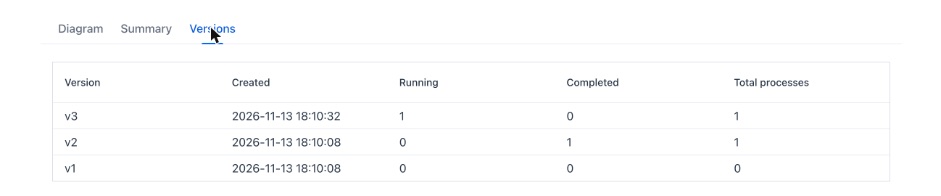
BOOKING-8 kept the version it started on — it finished on v2 once its approval was decided — while BOOKING-9 runs the new one. Nothing was interrupted. (The extra row is an artefact of this setup: the app imported the same file twice, once from its classpath and once from Git.)
To move the older bookings onto the new version — so they too draft the email — use Migrate instances… on the definition, or Migrate… on one run. check-migration in CI has already told you whether that is safe: see Part 9 · Automate it and Migrating running processes.
The whole loop
Section titled “The whole loop”- Edit the definition — in the IDE plugins’ graph editor or as text, validated as you type.
- Open a pull request: CI validates, runs the workflow tests and checks the migration.
- Merge: the webhook imports it; new processes run the new version; running ones keep theirs or are migrated.
That is the end of the workshop. You have built, broken, operated, debugged, tested and changed a real process — with about a hundred lines of definitions and four small handlers.